
If you’ve been dreading the weekly grocery run lately, you are definitely not alone. For months, a “cloud of uncertainty and worry” has hung over Canadian households as the cost of essentials continues to strain budgets.
In a major announcement aimed at tackling this exact issue, the federal government has unveiled the “Canada Groceries and Essentials Benefit.” Prime Minister Mark Carney framed the initiative not just as a quick fix, but as a “bridge to longer-term food security and affordability” in a shifting global economy.
But what does that actually mean for your wallet? And why is this announcement causing such a stir in Ottawa right now?
Here is a breakdown of the four things you need to know about Canada’s new grocery plan.
1. The Cold Hard Cash: What You’ll Get
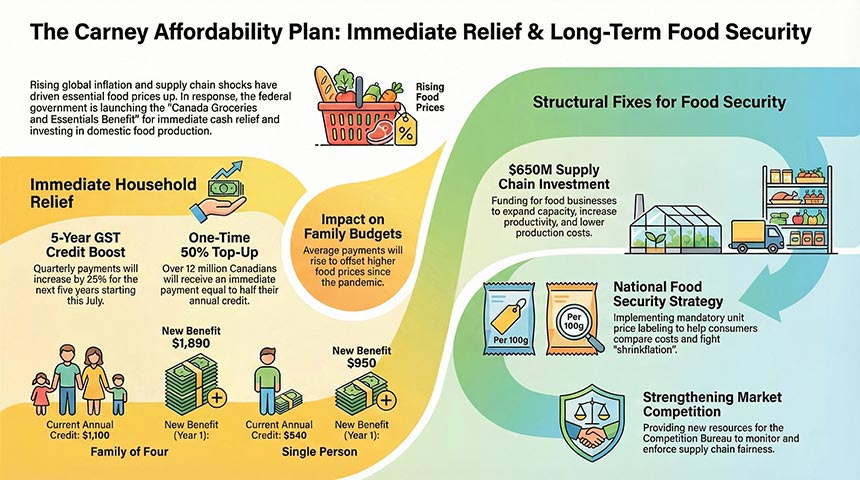
The centerpiece of this plan is getting money directly into the bank accounts of over 12 million Canadians by significantly boosting the existing GST credit.
The benefit is two-fold: A 25% increase to the credit for the next five years, plus an additional one-time payment this year (equivalent to 50% of the credit) for immediate help.
Here is the estimated financial impact:
-
For a family of four: Your annual benefit goes from roughly $1,100 to up to $1,890 this year, settling at around $1,400 for the next four years.
-
For a single person: Your annual benefit goes from roughly $540 to up to $950 this year, settling at around $700 for the next four years.
2. It’s a War on “Shrinkflation,” Too
While the immediate cash is the headline, the government insists this is part of a larger strategy to tackle the root causes of inflation.
Beyond the direct payments, they are investing $650 million to strengthen food supply chains and help businesses expand capacity. They are also tossing an immediate $20 million top-up to food banks to help with urgent local needs.
Perhaps most interestingly for the average shopper, a new National Food Security Strategy is targeting “shrinkflation”—that annoying practice where the product gets smaller but the price stays the same. The government wants to implement mandatory unit price labelling (showing the cost per 100g, for example), so you can easily compare real value regardless of the package size.
3. The Political Battlefield is Set
This announcement isn’t happening in a vacuum. Parliament has resumed, affordability is the number one issue, and an election loom.
The Conservatives immediately attacked the plan. Opposition House Leader Andrew Scheer called it a “recycled Trudeau-era policy” of just giving Canadians their own money back. The Conservative stance is that the better approach is permanently removing “Liberal taxes on food production” and ending inflationary spending.
According to political analyst Nik Nanos, this is strategic chess. By boosting the GST credit—which targets lower-to-middle-income households—the Liberals are making a direct play for a demographic feeling the most pressure, a group the Conservatives have been successfully courting recently.
4. The Surprise Twist: Young Voters are Driving This
Why the urgency from the government now? A startling new political trend might explain it.
Recent Nanos Research polling reveals that young Canadians are intensely focused on the cost of living. This economic pressure is causing a massive political realignment: young voters are now “more likely to vote Conservative.”
This breaks a 40-year trend where younger voters usually lean toward centrist or centre-left parties. The affordability crisis is reshaping the political landscape for an entire generation, and this Grocery Benefit is a clear attempt to win those voters back.
The Bottom Line
The government has rolled out a plan that offers immediate cash relief while trying to build longer-term solutions for supply chains and confusing pricing.
It’s a direct response to economic pain, but it’s also a calculated political move. The critical question now is whether this “bridge” to affordability will be built fast enough to change minds before Canadians head to the polls.